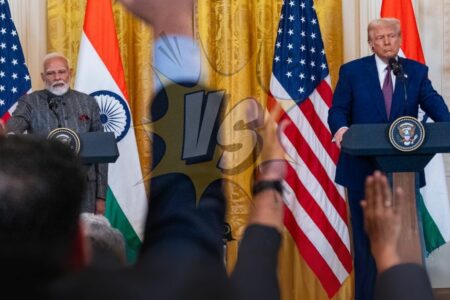


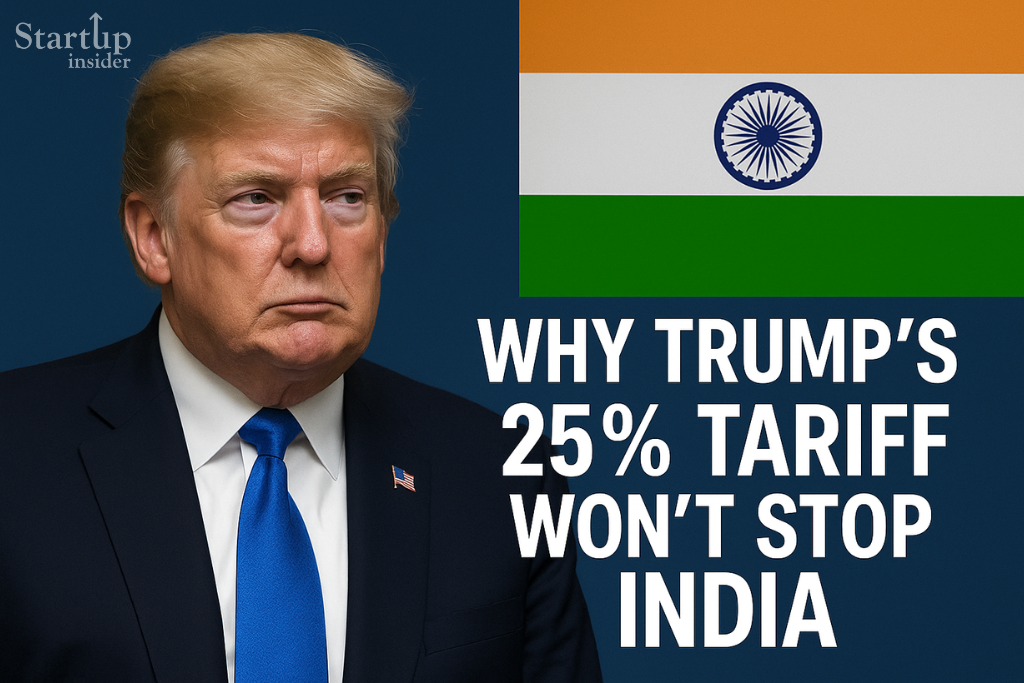
The warning shot in the form of a 25% reciprocal tariff on Indian imports issued by U.S. President Donald Trump may have rattled markets, but India’s economic fundamentals, policy buffers, and diversified trade strategy ensure that the headline risk remains just that—headline noise, not a structural derailment. Below are the key reasons why India is well-positioned to weather this storm.
1. Limited Macroeconomic Impact
Despite the eye-catching 25% rate, the overall GDP hit is projected to be modest:
-
A top India-based government source and an economist estimate the GDP loss at around 0.2% at most, translating to roughly ₹660 billion in FY 2025/26—a manageable drag given India’s ₹3.9 trillion economy.
-
Independent research by ICRA forecasts a 40-basis-point slowdown in growth, revising the FY 2026 GDP from 7% to 6.6%—well above global peers.
2. Strong Domestic Demand & Digital Transformation
-
India’s domestic consumption accounts for over 60% of its GDP and has been growing at a rate of 7% annually since 2019, thereby cushioning external shocks.
-
The Digital India and PLI schemes have channelled over $120 billion into manufacturing, IT, and semiconductor capacities, bolstering self-reliance and reducing import dependence in key sectors.
3. Diversified Export Markets
-
Exports to non-U.S. destinations such as the UAE ($31 billion) and ASEAN ($46 billion) have surged, mitigating reliance on the U.S. market.
-
Indian exporters are actively pursuing new agreements under India’s G20 presidency, strengthening ties across Africa, Latin America, and Southeast Asia.
4. Policy Preparedness & Ongoing Negotiations
-
India continues bilateral talks with the U.S., aiming for an interim trade deal that could secure 10–15% tariff levels for Indian goods—comparable to rates obtained by the UK and Japan.
-
Historical precedents, including earlier sector-specific reprieves during the Trump administration, suggest scope for rollback or carve-outs in sensitive industries.
5. Sectoral Resilience
-
Pharmaceuticals, which supply 40% of U.S. generics, enjoy structural pricing advantages and could negotiate margin adjustments rather than see outright volume loss.
-
Textiles and jewellery exporters can pivot to cost-competitive markets in South Asia and Africa, leveraging India’s scale and design capabilities.
6. Financial Markets & Investor Confidence
-
While export-oriented stocks may see short-term volatility, foreign portfolio inflows remain strong in domestically driven sectors—banking, infrastructure, and FMCG—reflecting faith in India’s long-term story.
-
India’s foreign exchange reserves of over $630 billion and a current account surplus position provide additional buffers against external shocks.
Conclusion
Trump’s 25% tariff announcement represents a tactical disruption, not a strategic derailment. India’s robust domestic market, diversified global trade ties, proactive policy measures, and ongoing negotiations ensure that any short-term sting will be absorbed without derailing the broader growth trajectory. As markets recalibrate, India’s long-term fundamentals remain intact—there is no cause for alarm-induced sleepless nights.
Source: India Today || Chatham House